The Living Sun
Our Sun is never still. From the dark patches of sunspots to the great eruptions of flares and coronal mass ejections, it rises and falls on an eleven-year cycle that stirs the Earth's magnetic field and drives the aurora at the poles. This is a guide to what the Sun is doing, and the space weather it sends our way.
Live imagery · NICT Space Weather Center · SDO / HMI · SILSO, Royal Observatory of Belgium
Solar Snapshot
The Sun as it appears today. The sunspot number tracks the daily count of active regions; the white-light image shows the spots themselves dark against the bright photosphere.
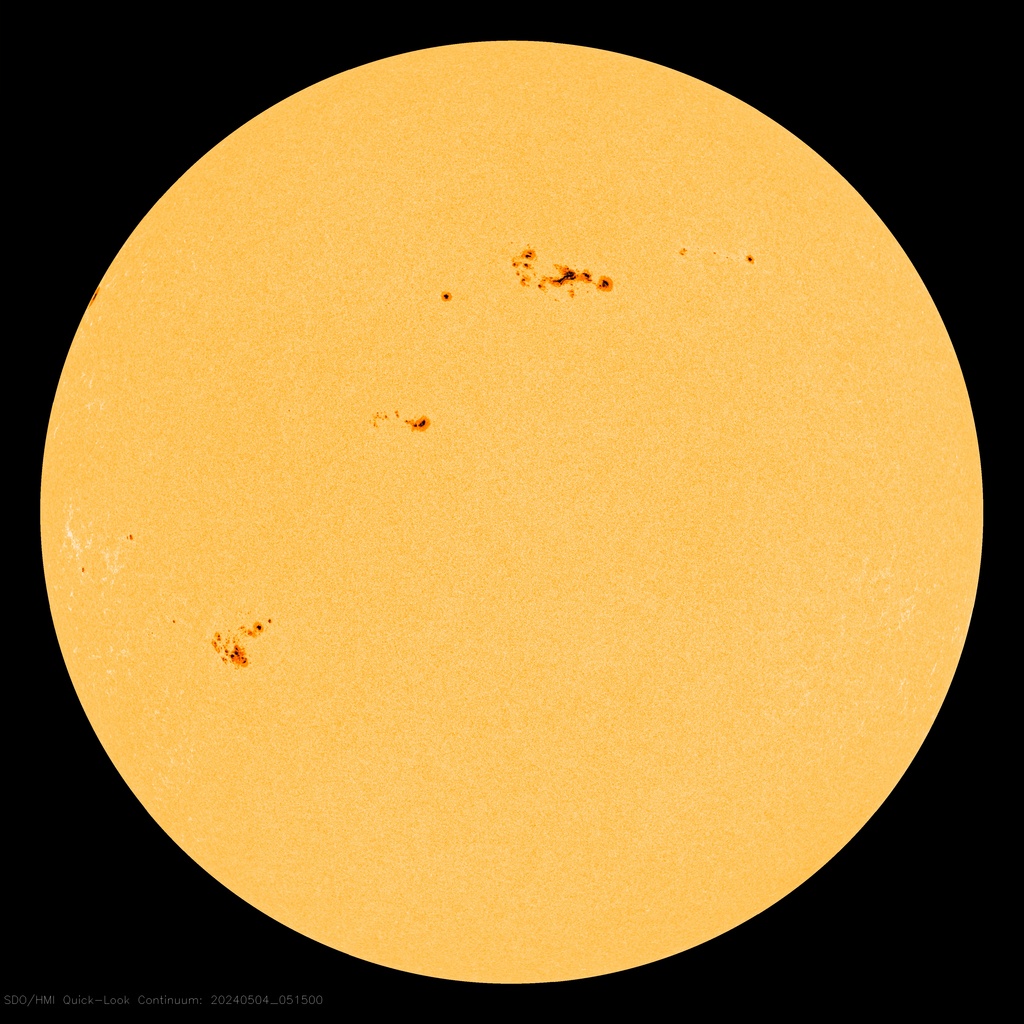
Current solar surface — SDO / HMI continuum (white light)
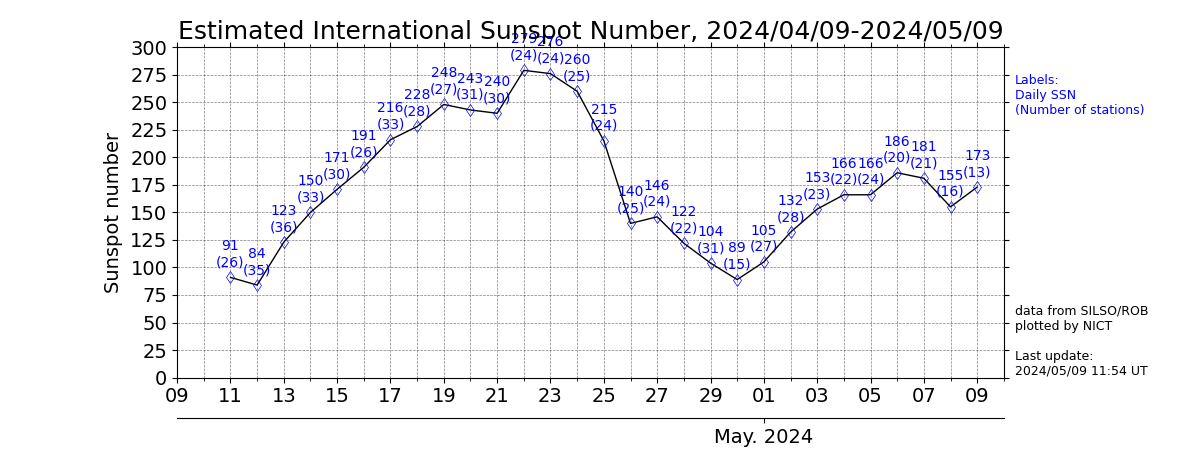
Estimated international sunspot number (SSN)
What Sunspots Are
Sunspots are cooler, darker patches on the Sun's visible surface, the photosphere, where intense magnetic fields choke the flow of heat from below. A typical sunspot is roughly the size of the Earth, and the largest can span many times that. They appear in pairs and groups, the two poles of a single magnetic loop piercing the surface.
Because they are magnetic, sunspots are the seeds of solar activity. Twisted fields above a spot group can snap, releasing flares; great loops of plasma can lift away as coronal mass ejections. The number of spots visible on the Sun's disc, the sunspot number, is the oldest and simplest measure of the Sun's mood.
The international sunspot number (SSN) is a daily index computed from observations at a network of observatories worldwide. A high SSN signals an active Sun; near zero, a quiet Sun. The record stretches back to 1749, the longest continuous measure of any natural phenomenon.
How Flares Are Ranked
A solar flare is a sudden, intense flash of radiation from a magnetically stressed active region. Flares are ranked by their X-ray brightness on five classes, each a tenfold step: A, B, C, M, and X. An X-class flare is the most powerful event the Sun produces.
The Solar Wind
The solar wind is a ceaseless stream of charged particles, mostly electrons and protons, flowing outward from the Sun's atmosphere at hundreds of kilometres a second. It carries the Sun's magnetic field with it, draping it across the planets and sculpting the Earth's magnetosphere. When the wind turns fast and gusty, the magnetosphere shudders and aurora flicker to life.
Proton Events
A solar proton event is a sudden surge of high-energy particles, accelerated by flares and shock fronts, that race outward from the Sun at near light-speed. These particles can reach Earth within tens of minutes, threatening astronauts and satellites and, at the surface, the polar ozone. They are the radiation storms of space weather.
What CMEs Are
A coronal mass ejection is the eruption of billions of tonnes of magnetised plasma from the Sun's outer atmosphere. Slower than a flare's radiation but far heavier, a CME can take one to three days to reach Earth. When its magnetic field points south, it couples with ours and unleashes a geomagnetic storm.
How Storms Are Graded
When a CME or a gust of fast solar wind strikes the Earth's magnetic field, the field shudders. The disturbance is measured by the Kp index, a worldwide 0–9 scale, and graded G1 to G5. The greater the storm, the lower the latitude the aurora can reach.
Aurora at high latitudes.
Weak power-grid fluctuations; migratory animals affected.
Aurora reaches +57° latitude.
HF radio fades at high latitudes; transformer alarms.
Aurora reaches +50° latitude.
Satellite navigation degraded; HF radio intermittent.
Aurora reaches +45° latitude.
Widespread voltage control problems; satellite orientation issues.
Aurora reaches the tropics.
Grid blackouts; long-lasting radio blackout; satellites lost.
The Eleven-Year Cycle
The Schwabe cycle is the Sun's ~11-year heartbeat. Activity rises from minimum, through maximum, and falls again to the next minimum, the Sun's magnetic poles flipping at each peak. The numbering began in 1755; we are now in Solar Cycle 25, climbing toward a maximum expected in the mid-2020s.
Few or no sunspots; a quiet Sun, gentle space weather.
Spots and flares multiply as the cycle builds toward maximum.
Peak sunspot count; the largest flares and CMEs cluster here.
Activity falls, though major storms often strike on the decline.
Key Terms
The visible surface of the Sun, the layer from which sunlight escapes.
A thin reddish layer above the photosphere, seen during total eclipses.
The Sun's outer atmosphere of searing plasma, visible as a halo during an eclipse.
A cooler, magnetically intense dark patch on the photosphere.
A sudden, intense burst of radiation from a magnetically stressed active region.
A massive eruption of magnetised plasma from the corona.
The continuous outflow of charged particles from the Sun.
A surge of high-energy particles from the Sun, a radiation storm.
A disturbance of the Earth's magnetic field driven by the solar wind.
A 0–9 measure of geomagnetic disturbance, averaged worldwide.
The magnetic cavity carved around the Earth by the solar wind.
Glowing light in the polar skies, lit by particles striking the upper atmosphere.
The Sun's activity rises and falls on the Schwabe cycle, roughly eleven years from one minimum to the next. We are presently climbing the active phase of Solar Cycle 25, a period of heightened sunspots, flares, and geomagnetic storms.